
The Role of NAND Flash Controller Technology in the AI Era
 Date
Industry
Date
Industry
In the AI era, NAND Flash Controllers are playing an increasingly important role in determining the performance and reliability of storage devices. As the AI Devices market continues to expand, demand is also growing rapidly for storage technologies optimized for diverse environments. Based on its proprietary Controller SoC and Firmware technologies, AIO is responding to the evolving storage market while continuously strengthening its competitiveness in next-generation storage technologies.

Most of the digital devices we use today rely on stored data to operate. From photos and videos on smartphones to operating systems and applications, as well as information generated by automobiles and industrial equipment, much of the digital data that shapes our daily lives is stored in NAND Flash1. With the advancement of digital technology, NAND Flash has become a core storage technology for a wide range of electronic devices, and its role is becoming even more important in the AI era.
AI technology is rapidly expanding beyond data centers into a wide range of AI Devices2, including smartphones, AI PCs, automobiles, industrial equipment, and wearables. As AI services become increasingly integrated into everyday life, the volume of data that needs to be processed and stored is growing exponentially. As a result, the need for higher performance, reliable data storage and management, and low-power operation is also increasing.
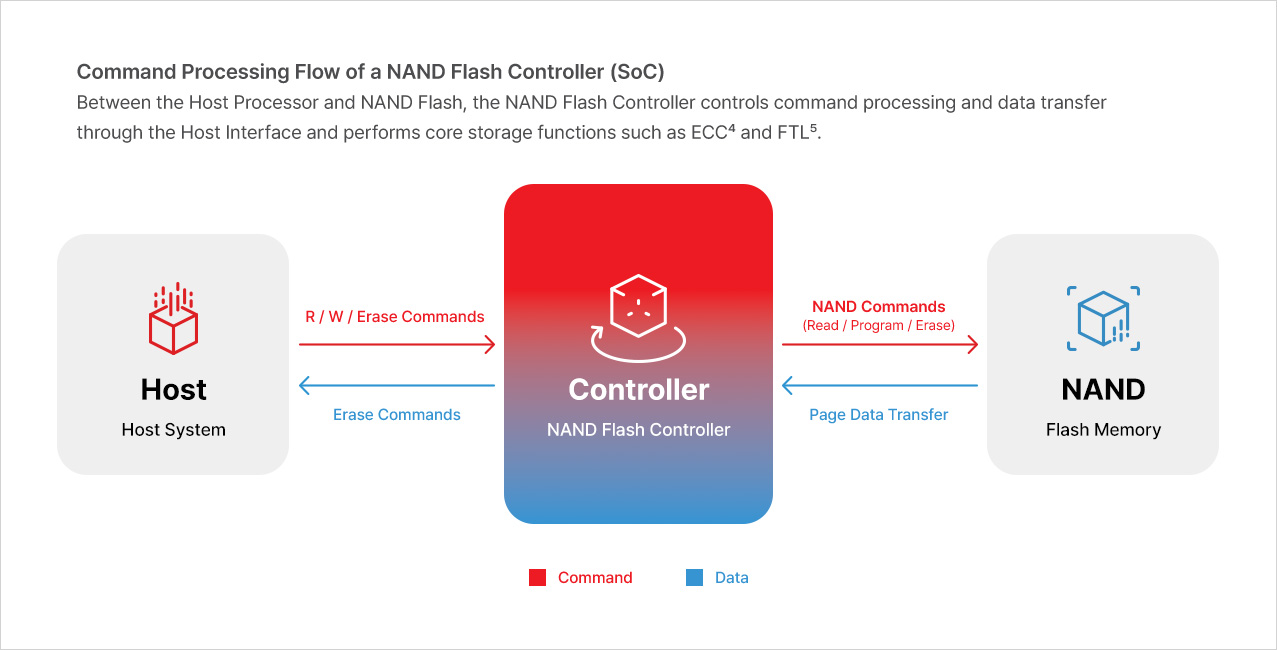
NAND Flash is non-volatile memory that retains data even when power is turned off and serves as a core storage medium for a wide range of electronic devices and storage products, including smartphones, SSDs, SD Cards, eMMC, and UFDs. NAND Flash stores data and provides page-level read and program operations and block-level erase operations, while the Controller3 handles Host command processing, data transfer, error correction, and storage space management. In this article, NAND Flash Controller refers to the Controller SoC and Firmware, including the Host Interface, ECC, and FTL, used in NAND-based storage devices such as eMMC, UFS, SSDs, SD Cards, and UFDs.
1 NAND Flash: A non-volatile memory semiconductor that retains data even when power is turned off. It is widely used in electronic devices and storage products such as smartphones, SSDs, and SD Cards.
2 AI Devices: Devices such as smartphones, AI PCs, automobiles, robots, and wearables that run or utilize AI directly on the device, rather than relying solely on the cloud.
3 Controller: A core control system that integrates Host Interface and NAND management functions to manage data read/write operations, error correction, storage space, and device lifespan.
4 ECC (Error Correction Code): A technology that automatically detects and corrects errors that occur during data read and write operations.
5 FTL (Flash Translation Layer): A Firmware technology that maps logical addresses requested by the Host to physical storage locations in NAND Flash and comprehensively manages storage space, endurance, and bad blocks. It includes functions such as Wear Leveling, Garbage Collection, and Bad Block Management.
NAND Flash Controllers: The Key to Storage Performance and Reliability
It is easy to assume that the performance of a storage device is determined primarily by the performance of NAND Flash. However, the actual performance, data integrity, and long-term reliability of a product are significantly influenced by NAND Flash Controller technology. NAND Flash serves as the storage medium, while the Controller is responsible for reading and writing data, correcting errors, and efficiently managing storage space. Even when the same NAND Flash is used, performance, power efficiency, endurance, and product lifespan can vary significantly depending on the Controller.
A NAND Flash Controller manages the flow of data between the Host Processor and NAND Flash. It interprets read and write commands from the operating system and applications, writes data to or reads data from the appropriate physical locations in NAND Flash, and corrects errors that occur during read operations. It also distributes data to prevent write and erase operations from being concentrated on specific NAND Blocks, manages Bad Blocks1, and reliably supports various Host Interfaces2 and NAND Flash configurations to maintain the required performance and reliability of the storage device.
As AI Devices become more widespread, storage is being used in increasingly diverse environments. Applications are expanding beyond smartphones and AI PCs to automobiles, industrial equipment, robotics, and other areas, making the requirements of each environment directly relevant to NAND Flash Controller technology.
AI workloads, in particular, place more specific demands on storage. Many on-device AI services load large models and related data from storage into memory during initial execution, meaning that model loading performance affects the startup latency experienced by users. When an entire model cannot remain resident in memory and required weights or data must be loaded from storage as needed, storage access may become more frequent. In such cases, storage read latency and power efficiency can affect service quality. In environments such as automobiles and industrial equipment, where devices are used for extended periods at high temperatures, data integrity and long-term reliability are essential requirements. Meeting these demands requires a combination of Controller technologies, including command and data processing, error correction, FTL-based storage space and endurance management, buffer management, and power management.
1 Bad Block: A memory area that cannot reliably store or read data due to repeated use, manufacturing processes, or other factors. The Controller automatically manages these areas to reduce the risk of data loss.
2 Host Interface: A connection and communication standard that enables the Host Processor and storage device to exchange commands and data. Examples include SD, eMMC, UFS, USB Mass Storage, SATA, and PCIe-based NVMe.
Core Functions of the Controller
- ECC: Data error detection and correction
- FTL: Logical-to-physical address translation and management of storage space, endurance, and bad blocks
- Wear Leveling: Prevents excessive wear on specific Blocks to optimize NAND endurance
- Garbage Collection: Moves valid data to other Blocks and erases existing Blocks to free up available space
- Bad Block Management: Management of bad blocks
- Buffer & Power Management: Improves data processing efficiency and enables low-power operation
- Host Interface: Host command and data communication

Changing Storage Requirements in the AI Era
The expansion of AI technology is reshaping storage product development and the R&D priorities of the memory industry. While some memory manufacturers are focusing their R&D capabilities on high-performance products for AI infrastructure, such as HBM and Enterprise SSDs, they are also improving development efficiency and market responsiveness for long-lifecycle products such as SD Cards, eMMC, and UFDs by collaborating with specialized Controller companies.
At the same time, NAND Flash technology is advancing rapidly. Increasing NAND Flash density and higher capacities enabled by TLC1 and QLC2 require more powerful ECC and sophisticated data reliability management technologies. Meanwhile, increasing interface speeds require improvements in Controller command processing performance, parallel processing, and buffer management capabilities. As a result, Controller Firmware, including advanced FTL, has become a key factor in storage competitiveness. NAND Flash Controller technology has evolved beyond simple interface functions into a core control platform responsible for everything from Host command processing to data integrity, storage space, and endurance management, while the Controller SoC serves as the key system semiconductor that implements these functions.
At the same time, NAND Flash Controller technology is becoming increasingly important for flexibly supporting diverse NAND Flash and Host environments and enabling the rapid development of products optimized for customer requirements. As the AI Devices market continues to expand, the role of Controller technology optimized for the requirements of individual products—including eMMC, UFS, SSDs, SD Cards, and UFDs—is expected to become even more important.
1 TLC (Triple-Level Cell): A NAND Flash technology that stores three bits of data in a single memory cell.
2 QLC (Quad-Level Cell): A NAND Flash technology that stores four bits of data in a single memory cell, providing higher storage capacity.
AIO’s Technology Vision for the AI Devices Era
The AI Devices market is expected to require an increasingly diverse range of storage solutions. Accordingly, Controller technology will become increasingly important, requiring not only higher performance but also data integrity, long-term reliability, low-power operation, and support for diverse Host Interfaces.
Building on the Controller SoC and Firmware expertise accumulated through the development and mass production of SD Card, eMMC, and UFD Controllers, AIO is expanding its R&D into next-generation storage technologies such as UFS and Client SSDs. AIO will continue to advance its next-generation storage platform technologies in response to the evolving AI Devices market and provide Storage Solutions optimized for a wide range of application environments.