
Reliability Built on Proven Controller Technology
 Date
Technology
Date
Technology
AIO designs and develops its Controller SoC and Firmware in-house and provides SD Card, eMMC, and UFD Controllers. Based on its proprietary Controller technology and proven mass-production experience, AIO consistently delivers the performance, quality, and compatibility required across diverse customer environments, providing reliable storage solutions.
The Controller That Determines NAND Flash Performance
As digital devices become more advanced, the requirements for storage devices are also rising rapidly. Across a wide range of device environments, including AI Devices, storage solutions are expected to deliver not only fast data processing, but also low power consumption, stable operation, and the endurance required for long-term use. Meeting these requirements depends not only on the performance of NAND Flash itself, but also on the Controller technology that manages it efficiently.
Even when the same NAND Flash is used, product performance, quality, and lifespan can vary significantly. The Controller is what makes the difference. Positioned between the Host and NAND Flash, the Controller performs core storage functions such as error correction (ECC), Flash Translation Layer (FTL), Wear Leveling, Garbage Collection, power management, and Host compatibility management. The design and implementation of these functions directly affect product performance and data integrity.
AIO designs and develops its Controller SoC and Firmware in-house and has continuously advanced core algorithms, including ECC1 and FTL2. Drawing on its development and mass-production experience across diverse NAND Flash and Host environments, AIO achieves a balanced combination of performance, quality, and compatibility, consistently delivering the performance and quality required by customers.
1 ECC (Error Correction Code): A technology that automatically detects and corrects errors that occur during data read and write operations.
2 FTL (Flash Translation Layer): A technology that maps logical addresses requested by the Host to physical storage locations in NAND Flash and manages the mapping.
LDPC ECC Technology for Next-Generation NAND Flash
As NAND Flash advances with each generation, storage capacity increases, but so do cell-to-cell interference and the likelihood of data errors. In particular, as conventional BCH-based ECC becomes increasingly insufficient to provide the required error correction performance in high-density NAND, LDPC (Low-Density Parity-Check) has become a key Controller technology for supporting next-generation NAND Flash.
LDPC provides stronger error correction performance than BCH, helping reduce data errors and ensure reliable data storage while supporting stable operation in high-density NAND environments. For these reasons, LDPC is widely used across the global memory industry as a key ECC technology for supporting the latest and next-generation NAND Flash.
To address these changes, AIO has developed a Controller incorporating 2KB LDPC ECC. By combining this with Firmware optimization technologies such as ORS (Optimal Read Search)1 and dynamic Bad Block Management2, AIO has achieved stable performance and high data integrity across varying NAND characteristics. This provides AIO with a technological foundation capable of flexibly supporting both the latest NAND Flash currently in mass production and future generations of NAND Flash. This capability represents an important technological advantage, enabling AIO to respond flexibly to changes in NAND Flash generations and process technologies while supporting stable, long-term product operation.
1 ORS (Optimal Read Search): A technology that identifies the optimal read voltage based on the condition of the NAND Flash to reduce data errors.
2 Bad Block Management: A technology that automatically manages memory areas that cannot reliably store or read data, helping prevent data loss.
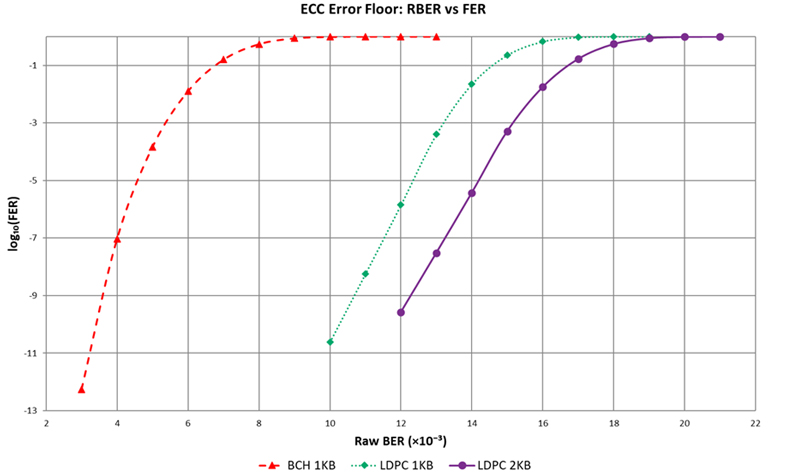
2KB LDPC ECC Optimization (Error Floor)
2KB LDPC ECC optimization delivers strong error correction performance and reliable data integrity even in high-density NAND environments. (Source: AIO R&D Center ECC Optimization Evaluation Data)

Proven Quality through Global Mass Production
A NAND Flash Controller must do more than simply function—it must deliver consistent performance and quality across diverse Host and NAND Flash environments. To achieve this, it must pass rigorous Qualification1 processes conducted by memory manufacturers and customers and undergo quality validation in actual mass-production environments.
Based on its proprietary Tailorable Architecture2, AIO designs Controllers optimized for various combinations of Host and NAND Flash environments, enabling rapid development tailored to customer requirements and high compatibility across diverse environments. These technological capabilities have provided the foundation for successfully passing Qualification processes with major customers in Korea and overseas and advancing to global mass production.
In particular, AIO’s SD Controllers have been deployed in a wide range of mass-produced SD Card products, demonstrating their performance, quality, and reliability in the global market. This demonstrates that AIO’s technology has moved beyond development to proven performance in actual mass-produced products.
This proven experience, spanning Qualification through mass-production deployment, is a key differentiator for AIO. It enables customers to reduce development time and risk while rapidly and reliably deploying proven Controllers across a wide range of product environments.
1 Qualification: A testing and evaluation process that verifies whether a semiconductor product meets a customer’s quality and performance requirements.
2 Tailorable Architecture: AIO’s proprietary Controller platform developed to enable flexible Controller design and optimization for diverse NAND Flash and Host environments.

AIO SD Controllers in Mass-Produced SD Card Products
AIO’s SD Controllers have been deployed in a wide range of mass-produced SD Card products, demonstrating their performance, quality, and reliability.

Optimized Performance and Power Efficiency
With the expansion of AI Devices and mobile video devices, storage solutions are increasingly required to deliver not only high performance, but also power efficiency, low heat generation, and cost competitiveness. In applications such as high-resolution video recording on smartphones, drones, action cameras, and industrial video devices, minimizing battery consumption and heat generation while reliably storing data over extended periods is particularly important. To address these changing market requirements, AIO has developed a UFD (USB Flash Drive)1 Controller optimized for performance and power efficiency.
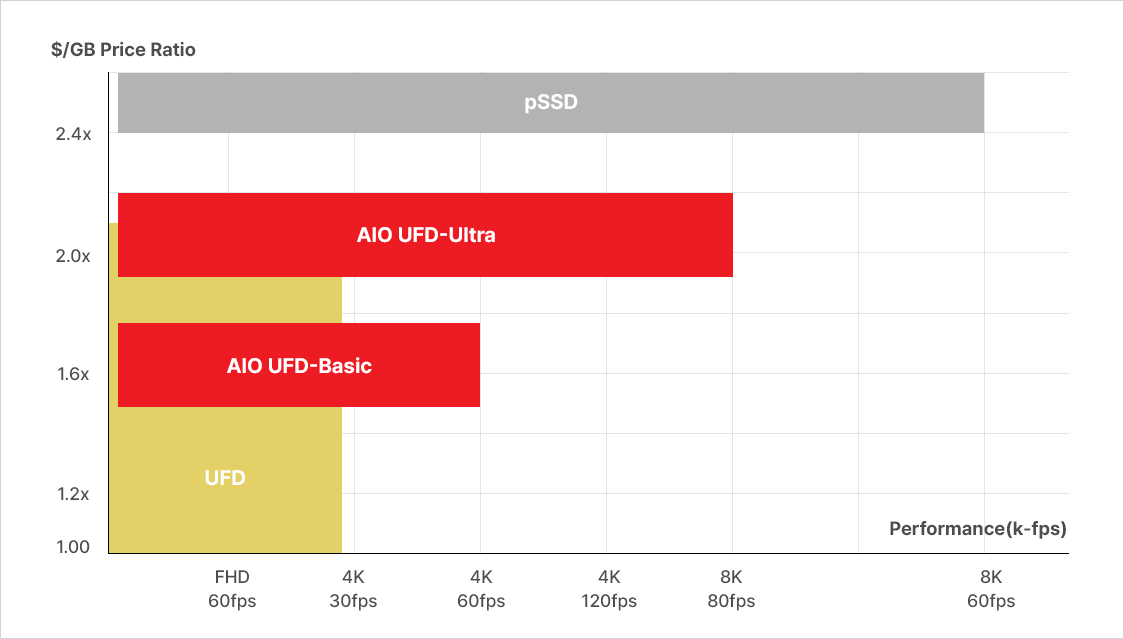
While Portable SSDs (pSSDs)2 provide high data transfer performance, their high-performance interfaces and complex system architectures tend to increase power consumption, heat generation, and product cost. In contrast, UFDs can deliver the performance required by various AI Devices while simplifying the system architecture, enabling both power efficiency and cost competitiveness. This makes them well suited for mobile and other device environments.
AIO’s UFD Controller, based on USB 3.1 Gen 1, supports a maximum data bandwidth of 600 MB/s while achieving low power consumption, with a write current of approximately 163 mA and a read current of approximately 157 mA. It also supports an operating temperature range of 0°C to 70°C, enabling stable performance and reliable data storage across diverse operating environments.
The highest performance is not always the optimal choice. In environments that require continuous data storage, such as FHD and 4K video recording, stable sustained performance, low power consumption, and cost competitiveness can be more important than peak speed. Based on these characteristics, AIO’s UFD Controller is used across a wide range of AI Devices, including smartphones, drones, action cameras, in-vehicle video devices, and industrial equipment. AIO will continue to expand its applications to address the diverse storage requirements of the AI era.
1 UFD (USB Flash Drive): A flash storage device that uses a USB interface. Commonly available in the form of a USB flash drive, it is used to store and transfer data across a wide range of digital devices.
2 Portable SSD (pSSD): A portable SSD designed for high-speed data transfer. It delivers high performance but generally has higher power consumption, heat generation, and product cost.
UFD controller comparison (pSSD vs AIO UFD)
AIO’s UFD Controller delivers the performance required for AI Devices while offering lower power consumption and strong cost competitiveness compared with pSSDs.
| pSSD | AIO UFD | |
|---|---|---|
| Protocol | USB 3.1 Gen 2 | USB 3.1 Gen 1 |
| Interface speed (1 lane) | 10 Gbps | 5 Gbps |
| Interface speed (2 lane) | 20 Gbps | - |
| Max data bandwidth (1 lane) | 1200 MB/s | 600 MB/s |
| Write current (1 lane) | 496 mA | 163 mA |
| Read current (1 lane) | 437 mA | 157 mA |
| Standby current (1 lane) | 2.15 mA | 2.50 mA |
| Operating temperature | 0 ~ 45 °C | 0 ~ 70 °C |
Proven Controller Technology, Expanding into Next-Generation Storage
The storage market is rapidly expanding beyond SD Cards and eMMC to UFD, UFS, cSSD, and other solutions. While product form factors continue to evolve, Controller technology that reliably supports next-generation NAND Flash and proven quality across diverse Host environments will remain key to storage competitiveness.
Based on its proprietary Tailorable Architecture and core Controller technologies, AIO has successfully commercialized SD Card, eMMC, and UFD Controllers, with its technology and quality proven through global mass production. This technology and experience provide the foundation not only for developing Controllers optimized for diverse customer requirements, but also for rapidly responding to Qualification requirements and establishing a stable mass-production system.
Building on its accumulated Controller technologies, AIO continues to expand its capabilities into next-generation storage platforms such as UFS and cSSD. AIO will also focus on developing next-generation Controllers and storage platforms to address the diverse storage requirements of the AI Devices era.